Showing posts with label Human Rights. Show all posts

Sunday, November 22, 2015

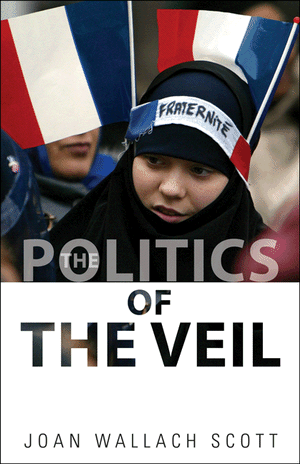
Politics of the Veil


Source: http://press.princeton.edu/images/k8497.gif

In Politics of the Veil, it is argued that the veil should be banned because it is thought that the veil takes away sexual freedoms of women. Politics of the Veil also argues that banning veils would be good since it will force the museum population to look more like the rest of us so ‘they could fit in.’ Also, there is an assumption that the veil makes someone look like a terrorist. As someone who believes in human rights, that statement sends shivers down my spine.

 Earlier in the semester, we discussed in class about the United Nation’s declaration of Human Rights (http://www.un.org/en/universal-declaration-human-rights/). Article 2 of the declaration grants people religious freedoms.  The United Nation declaration is not officially adapted by any nation. Despite that, the French constitution still does grant their citizens religious freedoms.

Politics of the Veil presented me with several arguments why the veil should be banned. None of them convinced me this was a good thing. Wearing a veil is an integral part of a Muslim woman’s belief. Each individual should have the right to express themselves in any way they want, as long as it is not a danger to others, and there should be nothing wrong with a women choosing to cover up more than the average citizen.

Islam is the fastest growing religion in the world. Politics of the Veil talks about how it is growing in France. I would like to link this to my research to Brazil.

At one point in Brazil’s history, Roman Catholic was the official religion of Brazil. However, their new constitution eliminates Roman Catholic as an official religion, and Brazilians have religious freedom.  Because of the history, Roman Catholic is still the predominant religion in Brazil. (https://en.wikipedia.org/wiki/Religion_in_Brazil)

As mentioned in previous posts, Brazil has a bad reputation when it comes to slavery. Many slaves in Brazil were African Islamic. The 1% of today’s Brazil population that practices Islam comes from those families. (https://en.wikipedia.org/wiki/Islam_in_Brazil) Despite the fact that they only represent 1% of the population, they still have religious freedom. With all the craziness down there, I don’t hear of any stories of Brazil trying to ban the veil.


Religious freedom is a basic human right. Banning the veil, or any other religious clothing for that matter, is a direct violation of that right. People should be able to practice whatever religion they would like, and wear what they would like, just as long as they are doing it peacefully. 

Sunday, November 15, 2015

Sex Trafficking in Brazil

               
Sex Trafficking in action. Source: http://www.neontommy.com/sites/default/files/users/user1031/BqJs7dZIIAAzUkT.jpg

Unfortunately, anywhere you go, sex trafficking, or prostitution is a problem. It is defiantly an issue here in the states. However, since the US is a fairly wealthy country, it is not as big as a problem as it is elsewhere in the world.
               People don’t become a prostitute because they want to.  It is because they have no they have no other choice.  Females often sell their body’s for sex, just so they can have money to afford basic essentials such as food and shelter.  Typically, it is not a source of disposable income.
               In Brazil, human trafficking is a huge problem. I briefly hinted at it in a previous post about human rights. (http://globalatmusa.blogspot.com/2015/10/a-right-to-clean-earth.html). Given Brazil’s reputation of corruption and other dirty habits, it should not come as any surprise that it is a problem.
               Part of the reason prostitution is an issue in Brazil is the fact it is actually legal! Now, it is only legal if you are over the age of 18.  However, most prostitutes begin their career as young as age 13! (http://www.huffingtonpost.com/2014/06/12/world-cup-child-prostitution_n_5474716.html) Why do they start so young? They need the money.
               Sometimes, girls are forced onto the streets by their parents. Other times, girls sneak out on their own will, without permission or knowledge from their parents.
               There is also a black market industry called “Sex Tourism.” Basically this means that people from all over the world (especially from the states) travel to Brazil, just to have sex with a prostitute.
With the recent World Cup, and the upcoming Olympics, tourism will be on the rise in Brazil. With an increase in tourism, there will be an increase in sex tourism. Many girls are learning English, not necessary for the sake of bettering themselves, but so they can negotiate with English speaking tourists!
So what is the Brazilian government doing? Other than illegalizing the practice for minors, not much. (http://www.coha.org/forced-prostitution-and-modern-slavery-brazils-response/) First of all, there isn’t a clear definition of prostitution in Brazilian law. In fact, sex trafficking is barely mentioned in the law. It is not like the law explicably allows the practice, it is that it doesn’t now allow it.

Brazil is facing major corruption problems now. A lot of government officials are corrupt. It would not surprise me if government officials have sex with the prostitutes themselves.  Brazil does not have a good record of handling issues well, and I don’t picture them making a huge priority out of this. Until Brazil can get a honest, hardworking government, and better law enforcement, sex trafficking (and all other issues) will not be going away anytime soon.